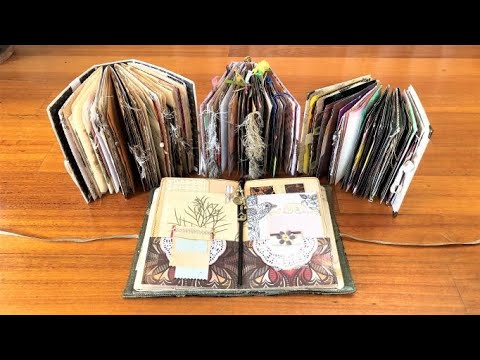
If you've been sitting on a collection of washi tape and wondering what to actually do with it, this video is a good place to start. I unbox a recent order from The Washi Tape Shop — botanical prints, faux postage sticker sheets, Van Gogh-inspired rolls, and some beautifully thin gold-threaded tapes — and then turn straight around and use them to build a gatefold-style journal from envelopes, paper bags, vellum, and book pages. The washi tape does real structural work here, not just decoration.
What we cover
This is part haul, part live project session. I show what came in the order — including the difference between traditional sticky washi tape and the sticker-backed sheets that are easier to work with for precise cutting — and then walk through building a multi-page gatefold journal where washi tape is the primary hinging method. Along the way I pull out an older gatefold album as a reference piece and talk through what I'd do differently.
What you'll learn
How to hinge single pages into a journal using washi tape, including:
- Laying the tape across two adjacent pages held flat, then peeling the backing as you go
- Applying tape to both sides of the hinge for double reinforcement
- Why I add glue as well — washi tape on its own isn't permanent, and for a hinge that needs to hold through repeated opening, glue gives it the staying power tape alone won't
The difference between sticky washi tape and sticker-backed washi sheets — and why the sticker-backed format is often easier to work with. When the tape isn't immediately sticky, you can measure and position exactly before committing, and you're not dealing with the tape grabbing everything it touches mid-application.
Why water-activated tape is not the right tool for paper hinging — it goes on wet, and it will warp your paper. I keep a roll around but it stays off journal pages.
How to build a gatefold journal structure using envelopes, paper bags, and single sheets — the idea being that each element is hinged or glued to a vellum base so the pages open alternately left and right, accordion-style. Envelopes attach with their existing flaps glued down; loose single pages and vellum sheets get hinged in with washi tape.
How to add a ribbon closure using a brad — threading sari silk ribbon through a pocket or CD sleeve and fixing it with a single brad, then tying a bow to close the whole structure. Simple, and it keeps the front panel clean.
How to make a quick flip-up notepad panel for the back of a journal — gluing or hinging a small pad of pages so it sits flush but lifts up, adding a functional writing surface to what might otherwise be dead space.
Using washi tape as decorative accent and focal detail, including:
- Cutting a butterfly or small motif from a sticker-backed sheet and placing it as a focal piece inside a panel
- Layering washi strips over hinges so the structural tape becomes part of the visual design
- Using thin washi tape rolls to edge sections or add stripe accents
What a finished gatefold album can hold — from the older album I show as reference: pockets, pull-out sections, tags, envelopes, and layered compartments that open in both directions. The format is genuinely expandable; I kept adding elements throughout this session and could have kept going.
Tips & gotchas
Washi tape is not a permanent adhesive. For hinges that will take regular handling — pages you'll open and close dozens of times — back it up with glue. Tape alone will eventually lift, especially on heavier papers or paper bags.
When sizing your hinge strip, cut a little longer than you think you need. It's much easier to trim a small overhang than to re-do a hinge that came up short at one end.
Applying tape on both sides of the hinge makes a real difference. It doubles the contact surface and keeps the hinge from rolling or peeling back when the page is opened flat.
If you're working with the sticker-backed sheets rather than traditional washi rolls, unroll or unfold only as much as you need before you start peeling — the non-sticky format gives you control, but if you accidentally peel the whole backing off at once, you lose that advantage fast. (I did exactly this mid-project, and it cost me a good strip of tape trying to work with it sticky-side free.)
The single biggest structural mistake you can make with a gatefold is measuring the two sides at different heights. I have an older album sitting on my shelf right now where one panel came out a quarter inch taller than the other, and nothing aligns properly. Measure both sides against the same reference before you cut — it seems obvious, but it's an easy thing to rush.
Working through it here — improvising the structure, hinging as I went, layering in pockets and tags — made me want to do a proper dedicated tutorial for it, with the steps worked out properly from the start. There's so much room in the format: pull-out sections, double-sided pockets, panels that open in both directions. Washi tape, it turns out, is a natural fit for that kind of structure — not just for decoration, but as the actual joints that hold it together.