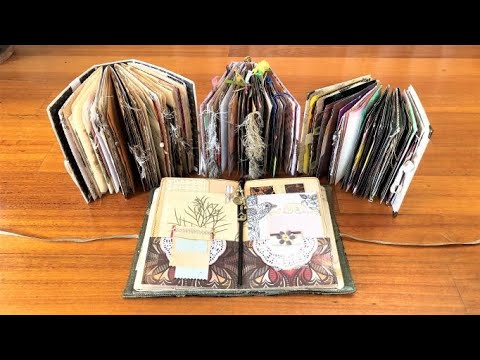
These two twine-bound junk journals started life as Reader's Digest books — and in this flip-through, I walk through both of them before they head up to my Etsy shop. If you've been curious about twine binding as an alternative to sewing signatures in, or you want to see how I approach minimally embellished journals with plenty of writing space, this is a good one to sit with.
What we cover
A close look at two altered-book junk journals made from Reader's Digest hardcovers — both using twine binding, tea-dyed pages, and an assortment of papers. I flip through the first journal page by page, talking through the materials and construction choices, then do a quicker pass through the second. Along the way I explain why I use twine binding, how the covers are reinforced and protected, and what makes these journals practical for everyday use.
What you'll learn
How twine binding works — and why I like it
Twine binding means the signatures sit inside the cover but aren't sewn in. That one difference opens up a lot:
- You can remove a signature if you want
- You can add your own loose papers, smaller scraps, whatever you feel like tucking in as you journal
- The book sits noticeably flatter than it would with sewn-in signatures — which I find genuinely useful when you're writing across a spread
How to use an intact Reader's Digest hardcover as your base
I didn't build a new spine or reconstruct the cover from scratch — I kept the original book structure and worked with it. The text block comes out, the cover stays, and then it's a matter of covering and protecting what's already there. This is a much faster starting point than building from board.
How to cover and seal an altered book cover for durability
The outside of the Reader's Digest spine and boards are covered with paper, painted with gold paint, then sealed and varnished on both sides. Everything is well adhered before varnish goes on — the varnish is protection, not a substitute for good gluing underneath.
Why I reinforce the spine on the inside with calico
The inside spine gets a strip of calico (or muslin, if you're in the US) before anything else goes in. On a book that's going to be opened and closed constantly, that reinforcement is what keeps the spine from eventually cracking or separating. It's a small step that makes a real difference to how long the book lasts.
How to build a minimally embellished signature
Each journal has five signatures, totalling 140 pages front and back. The pages are an assortment — tea-dyed paper, lined paper, scrapbook paper, old book pages — with a little stamping, some lace (mostly glued, some sewn), small pockets, and journaling spots. The philosophy here is deliberate: enough visual interest to make flipping through feel good, enough open space to actually write in.
The difference between gluing and sewing lace and embellishments
In these journals, most of the lace is glued down rather than sewn. Both approaches appear in the flip-through, and I talk honestly about when I've moved toward sewing most embellishments in my more recent work — and why, when I'm building something I want to last.
Tips & gotchas
Twine binding lets you add or remove pages as you go, which makes it genuinely practical for someone who journals over months rather than sitting down and filling a whole book at once. That flexibility is most of the reason I come back to it.
The flat opening is a real benefit that's easy to underestimate until you've written in a book that won't lie flat. Sewn-in signatures create tension at the spine; twine binding doesn't, so the book rests open without you holding it down.
When you're covering the outside of an altered book, seal and varnish everything — both sides of any paper you glue on, and the surface underneath where possible. The varnish isn't just for finish; it's what stops corners from lifting and paper from eventually peeling away from a well-used cover.
The calico or muslin reinforcement on the inside spine is worth doing even if the book feels solid before you add it. Old hardcovers can have brittle glue in the spine, and once that goes, the whole structure loosens. The calico strip bridges that and gives you something solid to work against.
If you've sewn through pages to attach lace or embellishments, you'll have thread ends hanging at the spine. I like leaving them — they're part of the look for me — but if you prefer a cleaner finish, they cut off cleanly without affecting anything structural.
The two journals in this video are on the plainer side intentionally. A lot of writing space, some visual interest on certain pages, nothing that competes with the writing itself. That balance is harder to get right than heavily decorated pages, and it's worth thinking about before you start filling signatures.