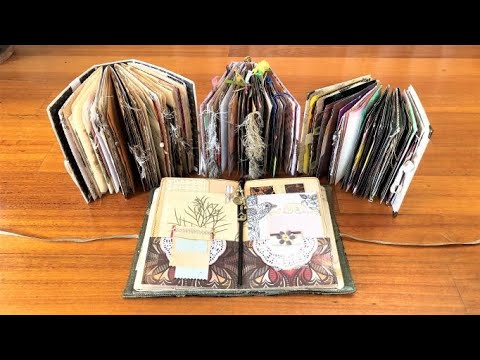
If you've been hoarding paper offcuts in folders and boxes, telling yourself you'll use them eventually — this short video is for you. I made a flag-style accordion book using nothing but scraps: leaf-shaped pages cut from paper bits, embellished with lace clusters, brads, little punched shapes, and printed phrases, all sewn into an accordion structure covered in upholstery fabric. It's the kind of project that feels genuinely satisfying to make, and even more satisfying to look at on a shelf.
What we cover
This is a flip-through of a completed accordion book — a decorative, feel-good piece built entirely from paper scraps and fabric remnants. I walk through the structure, the leaf-shaped pages, how I embellished them, and the different ways you could adapt this format for your own materials and ideas.
What you'll learn
What a flag-style accordion book looks like in practice — how the structure opens out, how the pages sit, and why it works as a decorative display piece as much as a journal.
How I used leaf-shaped paper scraps as the inner pages, including:
- Cutting leaf shapes from existing paper offcuts
- Embellishing individual leaves with lace, brads, scrapbook paper clusters, and fabric scraps
- Adding printed words and phrases (inspirational phrases, single words, short messages) to give each leaf its own feel
Why sewing isn't the only option for attaching pages — I sewed my leaves in, but you can glue them instead. Either way, you end up with the same basic structure: an accordion spine with pages that fan out when you open it.
How the accordion format invites variation, including:
- Full-sized rectangular pages instead of leaves
- Squares, rectangles, or triangular scrap pieces layered between leaves
- Pages left blank for embellishment, or written in as a proper journal — the structure supports both
Covering a book board with upholstery fabric — the cover on this one came from a reconstructed book, covered in upholstery fabric on the outside and scrapbook paper on the inside. It's sturdy, it's tactile, and it finishes the piece in a way that plain paper doesn't.
Using a scrap-paper organisaton system — I keep my offcuts sorted into folders, which makes it easy to actually reach for them when a project like this comes together. Not glamorous advice, but it's the thing that makes scrap-busting projects actually happen.
Tips & gotchas
Keep your paper offcuts organised, even loosely. I use a few folders and a box — nothing fancy — but having scraps sorted by rough size or colour means I can actually find what I want when I sit down to make something. If they're all in a pile, they stay in a pile.
You don't need to sew the pages in. Sewing gives a clean, secure result, but gluing works just as well for a decorative piece that's not going to be handled heavily. If you're not comfortable with an awl and needle yet, glue is a perfectly honest choice.
Mistakes are part of it. I accidentally sewed something in the wrong place on this book — and instead of starting over, I worked around it. That's not just a consolation; it's genuinely how some of the best details happen. If something goes wrong, sit with it for a minute before you decide it's ruined.
The leaf shape is one option, not the only one. Rectangles, squares, torn edges, triangular scraps tucked between leaves — the accordion format is forgiving. Whatever shapes your scraps happen to be, there's likely a way to make them work inside this structure.
The same basic structure works as a pocket-sized gift book, a gratitude display, a photo holder, a mini art journal — the spine stays the same and the pages change to suit whatever you're making it for. This one lives on my shelf and it makes me feel good every time I look at it. That's reason enough to make one.