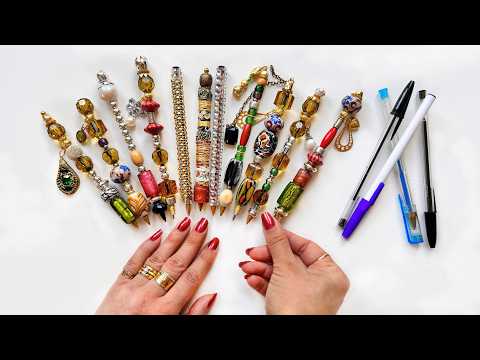
If you've got a junk drawer full of scraps, leftover pieces from previous projects, and a few bits of packaging you couldn't quite bring yourself to throw away — this video is going to feel very familiar. Episode 6 of the Trash to Treasure Chronicles is an impromptu crafting session where I pull together a whole collection of small journal elements and paper goodies to fill the Victorian-themed treasure box I made in Episode 5. No grand plan, no special supply run — just what's on the table and whatever the junk drawer offers up.
What we cover
This is a scrap-busting session focused on making a bundle of small, varied journal elements — a mini notebook, a scroll, a writing board, a little pouch, a collage piece, and more — all built from leftovers, packaging, old sticker sheets, wallpaper scraps, fabric bits, and found paper. The through-line is a loose Victorian theme that gives the whole collection a sense of cohesion without requiring me to overthink every decision.
What you'll learn
How to build a themed bundle of junk journal elements from leftover scraps, rather than making a single project. The bundle approach — a scroll here, a pouch there, a little diary, a writing board — gives you a richer, more interesting result than any single piece would on its own.
How to let a loose theme do the decision-making for you. I was working with a Victorian feel throughout, and that framing meant I didn't have to evaluate every scrap from scratch. Does it fit the mood? Keep it. Doesn't feel right? Back in the drawer. A theme acts as a quiet filter without turning the session into an assignment.
How to make a small signature booklet from whatever paper is at hand, including book pages and found paper, with hand stitching and small circle stickers to hide the knots on the inside.
How to turn packaging materials into functional journal elements, including:
- A glassine bag repurposed as a little pouch or holding wallet
- Sticker packaging paper used as a backing or collage layer
- A piece of wallpaper-like fabric paper rolled and tied into a scroll
How to secure old sticker paper with machine sewing. I had a full sheet of jelly-printed sticker paper that had started to peel with age — running it through the sewing machine not only held it down but added a lovely texture to the finished piece.
How to make a simple writing board / journaling panel from layered book pages, stamped and distressed, giving the queen — or whoever ends up using this — a surface for notes and collage work.
How to assemble a collage piece from pure scraps — fabric threads, torn paper, bits of ribbon and lace — when you've genuinely run out of structured materials but still have something left to make.
Why working only with what's immediately in front of you matters. The whole session was intentionally constrained: no pulling from the big vintage folder right behind me, no searching for the perfect sticker. What's on the table is what I work with. That constraint is what makes the session actually productive rather than a two-hour rummage.
Tips & gotchas
Start with your leftover scraps, not your good stash. The leftovers from the previous project are the natural starting point — they already share a colour palette and feel, so the new elements integrate without effort. Raiding your nicest supplies first usually leads to either hoarding paralysis or using something you'll regret.
Having a theme or framework is not the same as having a plan. I didn't know what I was going to make when I sat down. But once "Victorian" was in my head, every piece of packaging, every scrap of book page, every bit of lace got evaluated through that lens. It's a surprisingly efficient way to make creative decisions quickly, especially in a short session.
Don't go looking for the perfect piece. The moment you start rummaging for that one ideal sticker or that specific bit of fabric you know is somewhere in the pile, you've left the creative session and entered the sorting-and-organising session. They're not the same thing. What's in front of you is enough — and often the constraints produce more interesting results than the "perfect" material would have anyway.
Old sticker paper peels — sewing over it saves it. If you have aged sticker sheets or jelly-printed sticker paper in your stash that's started to lift at the edges, don't discard it. Run it through the sewing machine with a simple straight or zigzag stitch. It holds the layers together, and the stitching adds character to something that would otherwise feel like a problem.
The bundle format takes the pressure off every individual piece. When you know you're making six or eight small things rather than one finished journal, it frees you up. A collage piece that's just "bits and pieces" is a perfectly fine element in a bundle. A writing board that's a bit rough is charming inside a treasure box. Not everything needs to carry the whole project.
A scroll, a little diary, a pouch, a writing board, a stamped collage panel. None of it took long. None of it required special materials. That's the whole point of this series, really — that a handful of scraps and a loose idea can become something worth keeping.