If you've got a scraps box sitting nearby — one of those containers where you throw offcuts of fabric, leftover paper, odd bits of lace and ribbon — this video is essentially a live experiment in what that box can actually produce. I pull out a handful of pieces at random and give myself 15 minutes to make something with them. No plan, no preparation, just what's in front of me.
What we cover
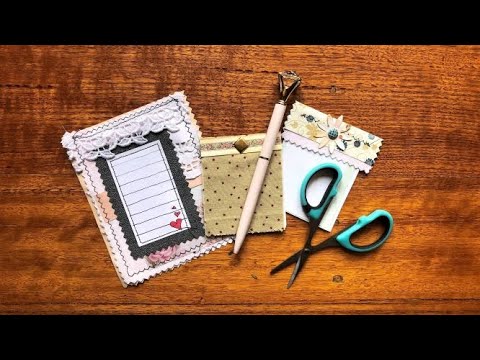
A spontaneous 15-minute scrap challenge, start to finish. I pull from my scraps box and make two (well, nearly three) small journal elements — a journaling spot layered from fabric and lace, and a mini booklet made from leftover paper scraps — using sewing, folding, a brad, a corner rounder, and a hair straightener standing in for an iron.
What you'll learn
How to build a journaling spot from fabric scraps and lace, layering pieces until something clicks — even when the thread colour isn't ideal and the composition happens by instinct rather than plan.
How to make a mini booklet from leftover paper scraps, including:
- Folding and stacking small rectangles and squares of scrap paper
- Adding a catalog page as a cover
- Sewing straight through the layers on a machine, then trimming the excess
How to finish a brad embellishment when you run out of thread mid-project — gluing the decorative layer down first, then pushing the brad through to hold everything together. Not the original plan, but it works.
How to use a hair straightener as a craft iron for small pieces of fabric, ribbon, or lace. My actual iron is upstairs, and for a few creased fabric scraps, a hair straightener does the job in seconds. I keep one at my desk specifically for this.
How to round corners on small journal elements to give them a finished, intentional look — even when the piece came together in under ten minutes.
Why things that look rough mid-process often land beautifully in a journal context — tucked into a pocket, clipped to a page, layered on a cover. The journal gives the piece its setting, and that changes everything.
Tips & gotchas
A hair straightener is genuinely useful for small ironing jobs at your desk. It's not a replacement for a proper iron on larger pieces, but for a strip of ribbon or a small square of fabric with a few creases, it's fast and it's right there. I keep one that I no longer use on my hair, and it's become a regular craft tool.
Running out of thread mid-project is almost a rite of passage in a timed challenge. Rethreading takes time — more than you'd think when you're in the flow. If you're going to do one of these challenges yourself, it helps to have a freshly wound bobbin or a spare one loaded and ready. I didn't, and I lost a few minutes (and bent my original plan) because of it.
The pieces in your scraps box probably look a bit nothing on their own — and that's fine. A small swatch of lace and a few torn paper rectangles don't have to be beautiful in isolation. Once they're placed in a journal, tucked into a pocket, or layered over a cover, they find their context. The journal does the framing work; your job is just to get them there.
Don't be too rigid about the 15 minutes. I wasn't — I went over, I rethreaded, I glued when I meant to sew. The point of the challenge isn't the clock, it's the constraint of using only what you've pulled out. That's where the creativity comes from.
The scraps that don't make it into the finished pieces aren't waste either. Even a small offcut that ended up too short can sit on top of a tag, or become the starting point for the next pull from the box. I keep almost everything, and it keeps paying off.
Once you've made a journaling spot from a strip of lace and a fabric offcut, it gets easier to see the potential in everything else in there — the catalog page, the odd bit of ribbon, the paper squares you couldn't bring yourself to throw away. These two small pieces came out of ten minutes of play and fit straight into a journal I was already working on. That's the whole point.