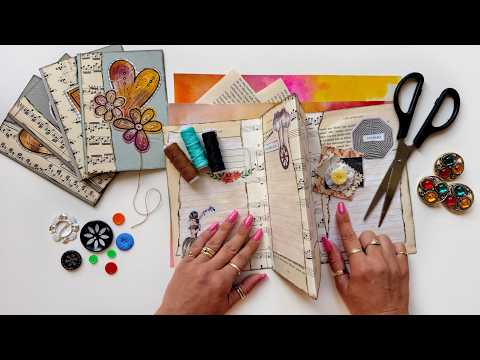
That feeling when you want to make something but also want to do absolutely nothing — I know it well, and I was right in the middle of it when I filmed this video. So instead of pushing through a project I'd planned, I did what I actually do when the motivation won't come: I started small, moved some energy around, and followed whatever came next. This video shows all three of those things, in real time, with no tidy outcome planned in advance.
What we cover
Three different approaches to getting out of a creative rut — a stepping stone project built from book pages and washi tape with no predetermined outcome, a short decluttering session in a junk drawer, and a watercolor doodling exercise that turns painted paper into cards and journal covers. Each one is a different type of activity, because what works one day doesn't always work the next.
What you'll learn
The stepping stone method — how to start making something when you have no idea what you're making, including:
- Joining four book pages with washi tape and folding them accordion-style as a first move
- Adding tea-dyed writing panels, music paper hinges, and found stickers as the next steps suggest themselves
- Inking edges, adding labels and sentiments from water-damaged books and random sticker sheets
- Letting the project lead you rather than planning an outcome in advance
Why cheap and random supplies are the right choice here — when you're trying to get the spark back, this isn't the moment for your best stickers or your precious papers. Use the random stuff, the things you've been meaning to deal with. That's exactly what they're for.
How to use a junk drawer as a creativity tool, including:
- Working through one small handful at a time rather than tipping everything out
- Throwing away things you haven't touched in years without guilt — more will come
- Noticing ideas as they surface (a stamped rabbit on a fabric scrap, five punched hearts and a brad, some chipboard slips) without feeling obliged to pursue every one
How to make painted watercolor paper with smooth color blending:
- Misting your paper before applying watercolor so the colors spread and blend without hard edges
- Covering the whole page in one pass, working wet-on-wet
- Making several sheets in a single session — one with full color, one near-monochrome — so you have options when you sit down to use them
How to doodle shapes on watercolor paper and turn them into something you actually love, including:
- Drawing hearts, flowers, circles, and squares loosely in Sharpie — imperfect on purpose
- Building up details with a thinner black pen: lines, dots, crisscross patterns, fake stitching
- Adding white pen for highlights and faux writing (correction fluid works fine if you don't have a white pen)
- Cutting out shapes and leaving a small edge rather than cutting right to the black line — that border makes everything look more considered
How to use your doodled shapes as the starting point for cards and journal covers:
- Folding cardstock in half or thirds and arranging the cut shapes across the panels
- Layering a doodled piece onto a book page first for an extra border effect
- Thinking through what the finished pieces could become: handmade cards for selling at markets, journal covers, covers for mini notebooks and booklets
Why motivation follows action — and what that actually means in practice — not as a productivity concept but as a practical starting point. You don't wait until you feel like it. You glue two pieces of paper together. You declutter one drawer. You put watercolor on a page. The feeling comes after the doing, not before.
Tips & gotchas
The most useful thing I can tell you: start so small it feels almost pointless. Not "I'll make a themed journal today" — more like "I'll glue two book pages together and see what happens." The moment you add the word and is when the motivation usually arrives. If you wait for the inspiration to show up first and then start, you'll be waiting a long time.
If one project just isn't doing it for you, give it up and try something completely different. When I was working on the fabric-and-yarn approach that eventually turned into last week's booklet video, the fabric stage left me feeling worse than when I started. Dropping it and moving to something simpler — paper sewn to paper — is what cracked it open. The stepping stone project and the decluttering and the watercolor doodling are all here precisely because different things work on different days.
For the junk drawer session: do one small section, not the whole room. The goal is movement, not a complete reorganization. One handful at a time. And be a bit ruthless — if it's been sitting at the bottom of a drawer for ten years and hasn't made it into a project, it's probably not going to. Clearing it out makes space, literally and otherwise.
When you're applying watercolor, mist the paper before you start. The colors will blend much more smoothly and you'll avoid those sharp edges where one color stops and another starts. It takes about thirty seconds and makes a real difference to how usable the finished paper is.
When cutting out your doodled shapes, resist the urge to cut right to the black outline. Leave a small edge. It looks better — cleaner and more intentional — and it gives you something to work with when you're layering onto another surface.
And with white pens: they're notorious for being temperamental. Have correction fluid nearby as a backup. You're doodling, not precision-drawing, so whatever you can get out of the pen is enough.
The doodled heart cards made me think about market stalls and cellophane packing and a little handwritten signature in the corner. Neither of those was the plan when I sat down. That's the whole point, really. You don't need to know where you're going when you start. The stepping stones take you somewhere, and the somewhere is usually better than whatever you'd planned.


