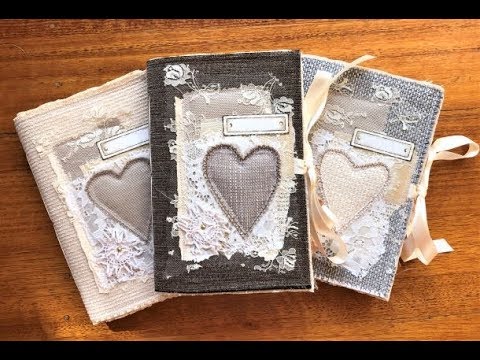
These three fabric-covered journals came together as both a creative project and an Etsy restock — and if you're curious what goes into a handmade junk journal built around upholstery fabric and old book pages, this flip-through shows all three in detail. Each journal shares the same structure and spirit while having its own palette and personality, and I walk through every spread: the pockets, tuck spots, doily imprint pages, little booklets made from offcuts, and the vintage book pages that anchor the whole thing. The covers were inspired by the work of Sonya M, a YouTube artist whose journals I've long admired.
What we cover
A flip-through of three finished upholstery fabric journals made for the TreasureBooks Etsy shop — each with two signatures, roughly forty pages, and a mix of writing space, pockets, foldout pages, tuck spots, and small internal booklets. Along the way I talk through the materials, the construction details, and a few things I'd do differently or plan to explore in future videos.
What you'll learn
How upholstery fabric works as a journal cover material — it's used on both the outside and the inside lining, with cardstock sandwiched between the two layers to give the cover structure. The result is firm but not rigid: no floppy covers, but it still feels warm and tactile.
Why the inside lining fabric can be left a little longer than the cover edge — on the third journal I deliberately left the inner fabric sticking out just slightly, and I really love that look. It's a small finishing decision that adds to the handmade feel rather than hiding it.
How a doily imprint technique creates texture on journal pages — you lay a doily down on the page and spray coffee or tea around it, leaving the doily's pattern behind when you lift it. I hadn't done this in a while and had to remind myself how it works, but the effect is genuinely beautiful — soft, aged, and very much in keeping with the vintage palette.
How to build cohesion across a whole journal's worth of pages — each journal uses book pages from a specific era (1883, 1902, 1920, 1922), a consistent color palette of creams, browns, and beiges, and materials like upholstery fabric scraps, lace, baking paper, and sequins that keep returning throughout. The goal is that everything feels like it belongs together.
How book pages function differently depending on how they're attached, including:
- Sewn-in pages become a permanent part of the journal's structure
- Pages attached with washi tape can be removed by the person who buys or uses the journal — useful when a page might be confusing or irrelevant to a particular journaler
- Genuinely interesting pages — a newspaper spread from July 1902, a record of events from March and April 1922 — earn their place as visual and historical anchors
How offcuts from making the journals become small booklets inside them — nothing gets wasted. The scraps left over from cutting the covers and pages get folded into tiny booklets that slot into pockets or sit inside tuck spots. It's a practical habit that also adds another layer of interest to the finished journal.
How pockets, tuck spots, and foldout pages can be distributed through a journal's signatures — in these journals, that includes paper bag pockets, fabric tuck spots with little word labels, sewn-in card clusters, and pages that fold out horizontally to reveal a full spread. The variety means a journaler encounters something different as they move through the book.
How a doily booklet can be made as a discrete internal element — I mention that I'm planning a dedicated video on these, but you'll see them tucked into pockets in two of the three journals here: small, folded booklets with a doily on the cover.
Tips & gotchas
When you're lining the inside of a fabric cover, don't trim the lining flush if you want a more decorative finish. Leaving it a few millimetres proud of the cover edge gives you a visible layered effect that actually photographs beautifully and reads as intentional rather than careless.
Book pages are one of the trickiest elements to include in a journal intended for someone else to use. A page from an 1883 newspaper is visually interesting — it has context, it has story. But a page from a typing exercise book or a technical manual might leave a journaler genuinely unsure what they're supposed to do with it. My approach: if the page has clear visual or historical interest, sew it in. If it's more ambiguous, attach it with washi tape so it can be removed cleanly if the person who buys the journal doesn't connect with it.
Offcuts are worth keeping in a dedicated scrap pile as you work. The pieces left over from trimming fabric, cutting pages, and shaping pockets are exactly the right scale for small internal booklets — and folding them into something useful rather than binning them is one of those habits that quietly improves every journal you make.
When you're working with a strong palette like the warm browns and creams in these journals, it's worth checking each new element against the whole before you commit to it. The cohesion in these three journals comes from consistently returning to the same tonal range — the tea-dyed and coffee-dyed papers, the upholstery fabric, the aged book pages all speak to each other. One element that reads too cool or too saturated can pull a spread out of that register.
The doily imprint technique is forgiving but it does require a light touch with the spray. Too much liquid and the doily imprint bleeds and loses its crisp edge. A light, even mist from a reasonable distance gives you that soft, lacy shadow without losing the detail.
The doily booklets I mention here got their own dedicated video not long after this one, and I was also planning at the time to do a video on what to actually do with old book pages inside a journal: how to use them, how to work with them, or how to cover them if they're not quite right for the spread you're building. If you're working with vintage materials and trying to make something that feels genuinely cohesive rather than randomly collected, these journals are a useful reference for how that can come together.


