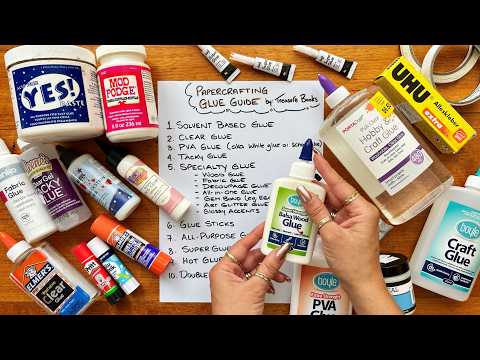
If you've ever stood in a craft store holding two bottles of glue that look almost identical and had absolutely no idea which one would wrinkle your paper into oblivion — this guide is for you. I made this video because the most common question I get is what glue do you use? And I kept answering it in bits and pieces across dozens of videos, which meant nobody was getting the full picture. So I did the research, I did the testing, and I put everything into one place: ten categories of glue, what each one is made of, whether it will warp your paper, and exactly what to look for on the label when you're standing in that store.
What we cover
This is a comprehensive walkthrough of ten glue types used in paper crafting and junk journaling — from solvent-based glue and PVA through to specialty formulations like fabric glue, Mod Podge, E6000, art glitter glue, and hot glue, finishing up with glue sticks and double-sided tape. For each type, I cover what it actually is, whether it warps paper and why, how to identify it from the label alone, and where it genuinely earns its place in a project.
What you'll learn
How to identify whether a glue is water-based or solvent-based without a label that tells you outright — because they almost never do. Things to look for include:
- Flammability warnings or hazard symbols (usually signals solvent-based)
- "Washable," "non-toxic," or "safe for children" (usually signals water-based)
- "Clean with acetone" or "sets quickly" (leans solvent-based — though test it, as I learned the hard way with one that fooled me completely)
- "Perfect for slime" (water-based, every time)
- "Water cleanup" or "use a damp cloth" (water-based, full stop)
Why water-based glues warp paper — and why understanding the mechanism actually helps you manage it. Water soaks into paper fibers, causing them to expand; as the water evaporates, they shrink back unevenly. Think of a kitchen sponge drying out. Once you understand that, the application technique advice makes sense rather than feeling like arbitrary rules.
How to apply PVA and other water-based glues to minimize warping, including:
- Applying with the nozzle directly — the worst outcome
- Applying with the nozzle, then spreading with a plastic card — noticeably better
- Spreading thin and even with a finger — the best result of the three, though there's still some warping on fine paper
What solvent-based glue actually does differently — it doesn't soak into paper fibers because it's acetone and alcohol-based, not water-based. It evaporates fast, leaves no trace if you rub off the excess, and produces literally no detectable warping even on very thin paper. This is my main working glue, and the testing I show in the video makes it very clear why.
The real purpose of glue sticks — and why I treat them as helpers, not the main glue — from personal experience: I journaled for a full year, stuck photographs down with glue stick on every page, and they all peeled off. Glue sticks are not designed for long-term bonding. I use them to coat an area that my solvent-based glue can't reach cleanly, then go over the top with the real adhesive. If you want a glue stick that performs better, look for "wrinkle-free," "extra strength," or "archival" on the label — those tend to have lower water content and curl the page less on application.
What Mod Podge actually is and why it does what it does — it's an all-in-one glue, meaning it combines adhesive, sealer, and finish in a single formula. The sealer component fills small gaps and prevents lifting; the finish is essentially a topcoat — matte, gloss, satin, or sparkle depending on the version. Very useful for collage and layered covers where you want everything locked flat. The downside: it can stay slightly tacky and cause journal pages to stick together if you're not careful.
Where each specialty glue earns its place:
- Wood glue — a modified PVA formulated for strength and sanding. Good for paper maché, hard book covers, anything needing a stiff, durable bond.
- Decoupage glue — a thinner, more fluid PVA, minimizes drag on fragile materials like napkins and tissue paper. Easy to make yourself with two parts PVA to one part water.
- Fabric glue — specifically formulated to stay flexible and survive washing. Worth having if you're applying fabric to journal covers; apply in a very thin layer so it doesn't seep through.
- Gem bond / E6000 — industrial-strength adhesive for non-porous surfaces: metal, glass, rhinestones, beads, book corners. Takes up to 24 hours to fully cure, but nothing moves after that.
- Glossy Accents (dimensional glue) — two jobs: strong adhesive for attaching metal embellishments and book corners, and a dimensional medium that can give a domed or glossy raised finish to project surfaces.
- Art glitter glue — water-based acrylic, but formulated to dry fast and grip quickly. Warps paper less than standard PVA. Originally made specifically so glitter wouldn't flake off; turned out crafters loved it for quick-grab applications like attaching lace.
- All-purpose glue — genuinely versatile: wood, metal, glass, fabric, leather, ceramics. The two I tested that don't warp paper are the UHU Extra Gel (has the hazard symbols — solvent component) and Yes! Paste (water-based but formulated to won't wrinkle light materials — I still don't fully understand the science, but the test result is clear).
Why hot glue is not a reliable adhesive for smooth or temperature-exposed surfaces — I learned this one expensively. I used hot glue to attach altered flip-top lids to journal covers, sold the journals, they flew to the US in cargo, and the temperature fluctuations caused every single one to pop right off on arrival. Hot glue is thermoplastic: it bonds well when it has texture to grip into (like lace, fabric, or porous surfaces), but on smooth plastic it can simply peel away. I still use my glue gun — lace flowers, attaching shank buttons — but never for anything that will live on a smooth surface or travel.
What double-sided tape will and won't do over time — it's semi-permanent. The adhesive degrades, and on porous or thin materials, it can bleed through and stain — I have a gifted handmade book sitting here with visible yellowing and gumminess coming through the surface. I still use it, but only sandwiched between layers where there's no chance of it showing (two cereal-box covers, for instance). Also worth knowing: double-sided tape has a shelf life of roughly two years — even unopened, it will lose its grip.
Tips & gotchas
Solvent-based glue has a strong smell, and because the acetone is evaporating as you work, it's going straight into the air around you. Open a window. Don't lean in and sniff the bottle. And while it comes off your skin like rubber erasings — which is genuinely useful — I'd still recommend not making a habit of getting it on your hands if you craft frequently.
When working with PVA, the thin-and-even application really does matter. A pool of glue applied directly from the nozzle is always going to warp more than the same glue spread flat with a card. If you're working with heavier paper or cardstock, the difference is much less dramatic than with fine paper — keep that in mind when you're testing.
Fabric glue needs to go on in a genuinely thin layer. If you apply it generously, it seeps through the fabric. The whole point is that it stays flexible and the surface feels soft — a thick application can undermine both.
Mod Podge and other all-in-one glues can stay tacky in humid conditions or if applied too thickly. If you're using it inside a journal where pages will be in contact, test first or use it on covers only.
If you're buying glue sticks and you want the ones with less page-curling behavior, those labelled "wrinkle-free," "extra strength," or "archival" are the ones to look for. Higher water content = more curling on application and weaker long-term bond.
On the archival topic: if you're making something you genuinely want to last, the archival quality of your adhesive is only one part of the equation. Acid-free glue glued onto acidic paper still has acidic paper in it. If archival longevity matters to you, it has to go all the way through — paper, glue, stickers, everything.
Double-sided tape used over thin or porous material will eventually bleed through visually. Keep it buried between layers. And check the age of your roll — tape that's past two years may already be losing grip before it ever touches your project.
For most paper crafting, that means building a small working kit: a solvent-based or non-water-warping all-purpose glue for anything you want to stay flat permanently, PVA for structural work and your DIY decoupage medium, fabric glue for textile covers, and glue sticks as the helpers they actually are. Everything else on the list has its specific moment — and now you'll know when that moment is.


