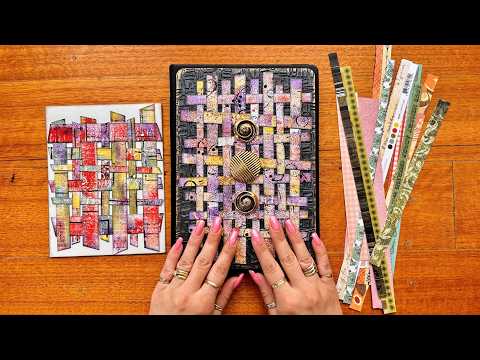
If you've ever ended up with a pile of leftover paper strips and no idea what to do with them, paper weaving might be exactly what you've been waiting for. In this tutorial, I work through multiple paper weaving techniques — from simple over-under strip weaving to cutting wiggly lines into a full sheet and threading strips through — and then show a whole collection of finished projects: journal covers, cards, tags, notebooks, and more. It's one of those techniques that starts simple and just keeps expanding the longer you sit with it.
What we cover
This is a hands-on exploration of paper weaving as a crafting technique — how to weave loose strips, how to cut slits into a base sheet and weave through those, how to cut windows into a finished woven piece, and how to take a completed woven panel and turn it into a journal cover, card, tag, or notebook cover. I also walk through a collection of finished examples that show how the same basic principle looks in very different materials and styles.
What you'll learn
How to do basic over-under strip weaving, including:
- Laying down vertical strips and weaving horizontal strips through in alternating passes
- Using washi tape to hold your vertical strips in place before you start weaving so things stop moving around
- Mixing strip widths — thicker strips, thinner strips, or all the same — for different effects
- Leaving gaps between strips for an open, airy look versus packing them tightly for a solid woven panel
How to cut slits into a base sheet and weave through them, including:
- Cutting straight parallel lines into a full sheet of paper (not cutting all the way through — leaving the sheet intact)
- Cutting wiggly lines instead of straight ones for a completely different visual effect
- Weaving strips through the slits — straight strips, wiggly-cut strips, or a mix of both
- Cutting the slits horizontally or vertically, and how that changes the orientation of the weaving
Why I ink the edges of strips before weaving — it takes a bit of time, but the difference between inked and uninked edges is immediately visible once things are woven together. Inked edges give the finished piece a more considered, polished look.
How to transfer a woven panel onto a project — gluing down all four edges of the woven piece first (lifting each strip, dabbing glue, pressing down), then turning it over and repeating on the back, before moving it to its final position on a card or journal cover.
How to cut windows into a finished woven piece, including:
- Sliding a plastic card underneath the area you want to cut so your X-Acto knife doesn't go through layers you want to keep
- Drawing a guide line first so you know where to cut and don't accidentally make the window larger than the piece underneath
- Why the window must stay smaller than whatever is behind it — cut too large and you get a hole straight through to the desk
Adding dimension on top of a finished woven piece, including:
- Weaving additional strips on top of already-woven strips for layering and extra depth
- Gluing strips directly on top rather than weaving them through
- Doodling, using gel pens or markers to outline windows, and stenciling over the surface
How the weaving principle extends beyond paper strips — I show examples using fishnet fruit netting with book pages woven through, fabric and vinyl scraps, yarn and thread, and oval cut shapes used as a frame for just four or five woven strips. The over-under principle works on almost any material you can thread something through.
Why painted or stamped handmade paper transforms when cut into strips — strips cut from a sheet of painted watercolor paper that looks unremarkable on its own can produce something stunning once woven. The texture and color variation that gets lost at full sheet size comes alive when the paper is cut down and interlaced.
Tips & gotchas
Ink your edges before you start weaving, not after. Once the strips are woven together, getting an ink pad to each individual edge cleanly is frustrating. Doing it beforehand takes more time but the result is worth it — you'll see the difference immediately when inked and uninked strips sit next to each other.
Washi tape is your friend at the start of a weaving session. Lay your vertical strips out in the order and spacing you want, then tape them down along the top edge before you begin threading horizontal strips through. It stops the whole arrangement from sliding around while you work.
When cutting windows, always slide a plastic card — or anything firm you can't cut through — underneath before you bring the X-Acto knife in. It protects the layers below and lets you cut cleanly without second-guessing. Draw your window shape first too, so you know where to stop. It's easy to get carried away and cut a window larger than the paper underneath, which gives you a hole rather than a frame.
A tightly woven piece holds itself together without any tape once you're done — you can pick it up and it won't fall apart. A loosely woven piece with gaps needs more care when transferring, but gluing all four edges down before you move it handles that.
Glue all four edges of your woven panel — both horizontal and vertical strips, on both front and back — before you try to apply it to a project. Skipping this step means strips shift or lift when you press the piece down, and you end up chasing loose ends.
Where this goes
What I've shown here is the foundational stuff — loose strip weaving, slit-and-weave on a base sheet, windows, layering. But there's a whole world beyond this: following printed weaving patterns (similar in logic to a crochet chart) to build specific designs, weaving through shaped cut-outs like circles or frames, mixing paper with fabric and fiber. I came into this video thinking I knew what I was going to make, and ended up discovering new directions mid-filming — the thread-and-fishnet piece, the oval frame with woven strips — things I hadn't done in any of the finished projects I'd prepared. That's the honest nature of this technique. Sit down with your strip collection and a quiet hour, and see where it takes you.


