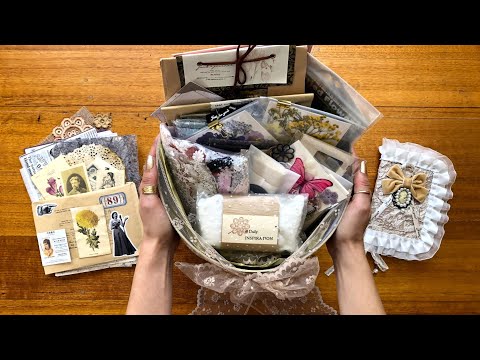
If you've been hunting for junk journal supplies that go beyond the usual — real dried botanicals, handmade papers with actual texture, laces you'd want to cut apart and rebuild — this haul from Taperlogy covers a lot of ground. I'm going through seventeen different products here, sharing what each one looks like up close, how I'd actually use them, and which ones genuinely surprised me.
What we cover
This is an unboxing and honest first-look at a curated selection of Taperlogy junk journal supplies — dried flower packs, strings and twine bundles, a mystery ephemera pack, a hand-stitched paper journal, rub-on transfer stickers, vellum butterfly stickers, handmade mesh papers, multiple lace and doily packs, die-cut material sets, and large vinyl flower stickers. I show each item up close, talk through how I'd use them in real projects, and share which ones I'd reach for first.
What you'll learn
What real dried and pressed flowers look like as a craft supply — and how they compare to pressing your own. These come in colour sets (yellow, purple, blue, green, pink, or all five), and I show you examples of how I use pressed botanicals: laminated into small tags, as part of layered journal pages, as standalone gift pieces. The quality genuinely surprised me — individual flowers that look almost like die-cuts, a leaf you can see through, real detail that your own pressed flowers might not always achieve.
How a strings and twine material pack works in practice, including:
- Using different string weights for tag toppers
- Tying journal closures
- Layering softer, finer strings with dried florals for a feminine feel
What comes in a mystery junk journal pack — and why that format is genuinely useful. This one includes transparent sticker labels, butterfly ephemera, doily-printed elements, twine offcuts, and ticket-style pieces. I talk through what I'd actually do with the pieces rather than just showing them.
How the hand-stitched paper journal is constructed — cardstock cover wrapped in fabric, lace trim around the edge, ribbon tied through the binding, beads on elastic for closure. It's the construction details that matter here: simple ideas I hadn't thought to use myself, like just tying a ribbon bow directly onto the binding so it's removable.
How rub-on transfer stickers work on fabric and paper, including:
- Using them on calico or muslin
- Working on smooth paper surfaces
- Why very textured materials are a trickier surface
What vellum botanical and butterfly stickers bring to a page — 50 stickers per pack, transparencies that layer well over other elements. I show how I'd use a single butterfly sticker to anchor a tag.
What's in the handmade mesh paper pack — a range of textures including mesh-weave materials, ribbed papers, and speckled handmade sheets. I talk through which textures I'd reach for first and why the variety in a single pack is useful when you're layering backgrounds.
How to think about lace as a cut-apart material rather than trim. The laces and doily packs contain 40 individual pieces of varying scale — I show how I cut individual flowers out of lace lengths, layer a paper flower underneath, and fix everything with a brad for a finished embellishment.
What the camera frame tag and dotted-line tags are for, including:
- Making specimen-card style inserts with a scrap of acetate
- Using the punched-out tags as-is in three colourways (kraft, cream, beige)
What's in the die-cut material pack — 55 pieces including frames (small and large), film strip motifs, teapot and mason jar shapes, butterfly cuts, and decorative elements that work well on journal covers. The pack contents vary slightly between orders, which keeps it interesting.
How large vinyl flower stickers differ from smaller decorative stickers — I've used these before and they're consistently my go-to for larger journals where a small sticker just disappears. The long vertical format in particular works well on A5 and larger covers.
Tips & gotchas
The rub-on transfer stickers have a surface requirement worth knowing: they work best on smooth materials. If you're applying them to muslin or calico, give the fabric a quick iron first — wrinkles and texture will break up the transfer. The good news is that if it works on muslin, it'll generally work on any thin, relatively smooth material, including paper.
The lace and doily paper sheets look like almost nothing when you hold them flat — I nearly dismissed them before I held one up to the light. Angle matters with these. Before you decide how to use them, try backlighting a sheet or layering it over a coloured background; the pattern reads completely differently.
For the mystery pack: resist the urge to use everything at once. The pieces in mine included both statement elements (the larger butterfly stickers, the doily prints) and quiet supporting pieces (twine offcuts, ticket scraps). The supporting pieces are what make the statement pieces land — they're worth keeping separate and reaching for when something needs grounding.
The dried flower packs come in individual colour sets or as a full set of five. If you're not sure which colours you'll actually use, the full set is worth it — I found I was more drawn to the purple and yellow sets than I expected, and having the full range meant I could match them to whatever I was working on.
For the laces doilies paper pack, you choose at checkout between four patterns with five sheets each, or five patterns with four sheets each. Neither is objectively better — it depends whether you want more of fewer designs or a wider variety. I'd think about which pattern you'd reach for most and make sure you're getting enough of that one.
The premium lace pack comes in classic white or coffee-and-tea dyed. The white laces are beautiful but the dyed ones photograph better alongside vintage papers and aged ephemera — worth considering if your journals tend to run warm and earthy rather than clean and bright.
The things that spark ideas aren't always the individual items but the combinations. That's what I keep coming back to with a haul like this: not "what is this thing?" but "what does this thing make possible when it's sitting next to that other thing?"


