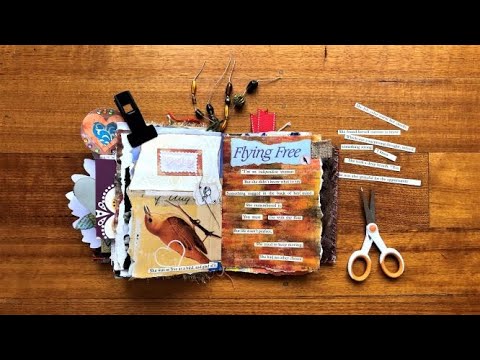
If you've been eyeing Tim Holtz quote stickers but balking at the price — or just looking for a meaningful way to work through a difficult stretch of time — this short video is for you. I'm working on an existing junk journal spread using words and phrases I've cut from a discarded library book, building them into something that feels like a found poem. It's simple, it's budget-friendly, and it turns out to be surprisingly personal.
What we cover
Working in a junk journal spread from start to finish using cut phrases from old book pages — picking words, assembling them into a cohesive poem, layering with small collage elements, and finishing the page with inking, a bird sticker, and a handmade tab.
What you'll learn
How to pull meaningful phrases from old book pages and assemble them into a found poem The technique isn't random — you're reading as you cut, looking for fragments that resonate emotionally or thematically. I pull a handful of phrases, lay them out, and let a thread emerge: an independent woman but she didn't know what to say… something nagged in the back of her mind… you must go with the flow… she had no other choice. The poem forms itself from what the book already contains.
How to choose a unifying image or theme before you start I found the phrase she was as free as a bird and glad of it early on, and I happened to have a bird image nearby — plus three small hearts cut from my daughter's outgrown top. That's the whole mood of the page settled before a single piece is glued down. Starting with a phrase-image pairing gives the spread direction without forcing it.
Why inking the edges of your cut phrases makes them work on any background This is the single finishing step that pulls everything together. Raw cut paper phrases can look pasted-on; inked edges give them weight and make them read as intentional. I ink both the cut phrases and any small paper offcuts I use as backgrounds, and the difference is real.
How to decide between cut edges and torn edges for paper elements I go back and forth on this in the video — straight-cut strips versus torn edges — and settle on torn because it softens the look and fits the organic feel of the spread. For phrases specifically, tearing (rather than cutting precisely around every word) also speeds things up without losing anything.
How to use fabric scraps and paper offcuts as collage layers The hearts on this page came from a fabric scrap — a small piece cut from a child's top that was too small to wear anymore. Paper offcuts from previous projects serve as small background strips under phrases. None of this is precious material; it's the box of bits that accumulates on the desk over time.
Why dating your journal entries during significant events matters I'm making this spread on 20 March 2020, during the early days of the pandemic lockdowns. I date the page and add small notes about daily life alongside it — because these are the moments that future readers (even just future you) will want to have recorded. The journal becomes a document, not just a craft project.
How a small tab can finish a spread and make you want to add more Almost as an afterthought, I add a little handmade tab to the edge of the page — and it immediately makes the spread feel more complete. One tab leads to thinking about adding them throughout the journal, which is exactly how small embellishments snowball in the best way.
Tips & gotchas
Ink the edges before you commit to placement, not after. Once phrases are glued down, getting clean edge coverage without touching the background is fiddly. Do it while the pieces are still loose in your hand.
Tearing instead of cutting straight gives a more organic result, especially for background strips. But torn edges benefit from inking more than cut edges, not less — the raw fibre catches the ink and the result looks intentional rather than rushed.
You genuinely don't need Tim Holtz quote stickers or anything like them. I have some on my desk — I've hoarded them because I spent real money on them and now feel reluctant to use them. The book phrases do the same job. Better, actually, because you choose exactly the words that fit what you're making rather than working around what a sticker pack happens to include.
If you're journaling through something difficult — a loss, a period of uncertainty, anything that feels unmoored — the found poem approach is worth trying not because it's therapeutic in some abstract sense, but because it gives you a structure when you don't have words of your own yet. You're borrowing the language until yours comes back.
Date significant pages. I say this in the video and I mean it seriously: the small details of ordinary life during extraordinary times are exactly what gets lost if nobody writes them down.
Once you have a running collection going, pages like this one come together in under an hour from a standing start. The found poem in this spread took shape in minutes; the real time was in the inking and layering. That's a good ratio.


